
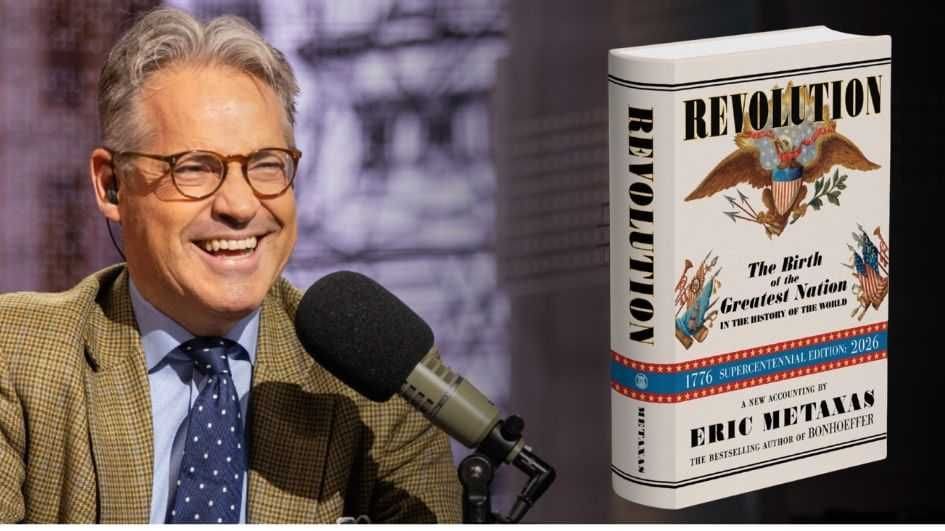
Since first garnering national attention with his 2011 biography “Bonhoeffer: Pastor, Martyr, Prophet, Spy,” author, radio host, and cultural commentator Eric Metaxas has become one of the most prominent Christian public intellectuals in American conservative life. A best-selling author whose books include “Martin Luther,” “If You Can Keep It,” and “Letter to the American Church,” Metaxas is now about to release “Revolution: The Birth of the Greatest Nation in the History of the World.” Weeks ahead of publication, he sat down with John Zmirak to discuss the American founding, the spiritual roots of the Revolution, and the modern crisis of civic memory.
John Zmirak: For the past 10 years or so, you and I have had a tradition: You write a deeply serious book on a very important topic, and I ask you impertinent, frivolous questions about it, which you answer with exasperated reluctance. Since “Revolution” is the biggest book you’ve published in some years, I thought we should do the same thing, but perhaps at greater length, if only to test the reader’s patience. Are you agreeable?
‘Perhaps the central idea is that apart from Christian faith, there would never have come into existence the nation called the United States of America.’
Eric Metaxas: More than agreeable! Fire away, sir!
John Zmirak: As you were writing the book, you were worried about the length. You forced yourself to leave out some offbeat, outrageous incidents and spurn some avenues of inquiry. First, can you tell us what you wish you had had room to cover? Second, did you consider other means of shortening the book — for instance, by leaving out all the verbs? I find that in most books, they just clutter things up. In many academic books published recently, authors largely eschew them, albeit to the detriment of readability …
Eric Metaxas: Yes, I wanted this to be a definite and comprehensive telling of the epic tale of America’s birth 250 years ago. So there’s a lot in it! Every famous story and every amazing hero and a few despicable villains. But for the record, I did not leave out any of the offbeat and outrageous incidents, simply because I couldn’t help myself and because they’re so wildly entertaining. For example, I had to include the scene at the Hellfire Club in which the maniacal, cross-eyed John Wilkes contrives to have a garishly costumed baboon leap onto the back of his archnemesis John Montague, the earl of Sandwich. Such scenes seem to me central to the wider story, somehow, because they give it the color we need to understand the period.
I hope people enjoy my chapter on the “Mischianza” celebration in Philadelphia, for example. Nor could I refrain from mentioning the “gastric lusts” of the stout and haughty imbecile that was General James Grant. And of course on the first page of the first chapter, I mention Sir Thomas Crapper in a footnote. I really do think including some of the stranger and more interesting details makes the book more fun to read, generally. That’s the hope!
But I genuinely wish I could have gone on for another 200 pages. Perhaps in a second edition I will do that. Depending on how the current edition is received, of course. But there really are so many stories I wanted to include but simply didn’t have room for. I was dying to include the story of the burning of my hometown, Danbury, Connecticut, by the monstrous British General Tryon, in which Benedict Arnold figures prominently, several years before his name literally became synonymous with traitor. Perhaps in the second edition, as I say.
’50-year drift’
John Zmirak: You’re publishing this book to mark the 250th anniversary of America’s founding, which pedants refer to as the “Septuagesima” or something. But you prevailed upon President Trump to start calling it by your own pet name, the “Supercentennial,” which is at once both less confusing and sillier. My first question: Given your close access to President Trump, do you think you could start feeding him my policy ideas? For instance, I want him to start a RICO investigation of the U.S. Catholic bishops for smuggling immigrants into the country and getting $5 billion in federal contracts over 15 years as their reward. Could you make that happen?
Second question: How would you compare the state of the country with its condition during the Bicentennial, which, given our ages, each of us remembers as a time of widespread patriotism, economic crisis, and acne? Are American elites promoting national pride, gratitude, and civic literacy the way they once did through the “Bicentennial Minutes” that used to show between episodes of “Felix the Cat” and “Huckleberry Hound”? Or are our elites doing something else entirely? And if so, why?
Eric Metaxas: I hesitate to point out that these are not really questions per se, but will overlook that detail and try to “answer” them. I also hesitate to point out that your numerals are a Potemkin village, only there to hide the fact that a host of actual questions lurk behind the papier-mâché numbers. But I will try to answer at least some of your many wonderful questions!
Yes, of course, I certainly can importune the president with any policy proposals you want to get in front of him, especially the brilliant one about the Catholic bishops! Consider it done. Or maybe I can just give you Susie Wiles’ private email address and you can pitch her on these ideas yourself. I’ll do that privately, of course, since Susie has asked me never to give out her personal email to people of your particular “ilk,” and when she said that, she mentioned you specifically and made a ghastly face.
Regarding the differences between the Bicentennial — which we both remember — and the Supercentennial we are currently experiencing, I think that yes, more Americans knew more about American history in 1976 than today, but I also think that the 50-year drift away from teaching American history and the subsequent drift away from our founding ideals has caused more Americans to wake up and become more patriotic than ever. The madness of what we’ve been through as a nation has caused many to realize we desperately need to know our history, which is precisely why I wrote the book. Let’s just say Ken Burns’ PBS homage to the Native Americans disguised as a series on the American Revolution doesn’t exactly help things, and I thought someone should step up.
‘A grand pair of tusks’
John Zmirak: As I mentioned when we talked about “Revolution” on your radio show, this is the first book that convinced me that the patriots were right, that the British abuses of colonists’ rights met the exacting criteria for just war, and that the American founders were actually the conservatives resisting a new ideology imposed by godless, arrogant elites. In that sense, the Boston Tea Party was a forerunner of the election integrity protests on January 6, 2021. Were there issues on which your research for this book made you change your mind? What did you learn that most surprised you?
Eric Metaxas: The most surprising thing I learned was that George Washington made many of his own dentures and at one point — on a lathe operated with a foot pedal in the basement at Mount Vernon — he fashioned for himself a grand pair of tusks that he thought “properly fitting to the august office of the nation’s chief executive,” which were of such size as “inspired the deepest reverence” in those in his company and which he more than once used to intimidate Jefferson and Hamilton into silence. Most biographies leave such tidbits out of the story, but I simply refuse to!
Unfortunately, the Smithsonian has the tusks hidden away in storage in an annex in Maryland. It is my belief that their absence from the actual exhibit in the museum on our national mall marks a monumental ellipsis in the great story of Washington’s presidency. Of course I might be making this up, but who will ever know? You’ll just have to read the book, I suppose.
‘Decadence of British elites’
John Zmirak: How aggressively secular had British elites become by 1763, when the conflict with the colonies began? How fervently Christian had Americans become in the meantime, under the influence of Se
John Zmirak: For the past 10 years or so, you and I have had a tradition: You write a deeply serious book on a very important topic, and I ask you impertinent, frivolous questions about it, which you answer with exasperated reluctance. Since “Revolution” is the biggest book you’ve published in some years, I thought we should do the same thing, but perhaps at greater length, if only to test the reader’s patience. Are you agreeable?
‘Perhaps the central idea is that apart from Christian faith, there would never have come into existence the nation called the United States of America.’
Eric Metaxas: More than agreeable! Fire away, sir!
John Zmirak: As you were writing the book, you were worried about the length. You forced yourself to leave out some offbeat, outrageous incidents and spurn some avenues of inquiry. First, can you tell us what you wish you had had room to cover? Second, did you consider other means of shortening the book — for instance, by leaving out all the verbs? I find that in most books, they just clutter things up. In many academic books published recently, authors largely eschew them, albeit to the detriment of readability …
Eric Metaxas: Yes, I wanted this to be a definite and comprehensive telling of the epic tale of America’s birth 250 years ago. So there’s a lot in it! Every famous story and every amazing hero and a few despicable villains. But for the record, I did not leave out any of the offbeat and outrageous incidents, simply because I couldn’t help myself and because they’re so wildly entertaining. For example, I had to include the scene at the Hellfire Club in which the maniacal, cross-eyed John Wilkes contrives to have a garishly costumed baboon leap onto the back of his archnemesis John Montague, the earl of Sandwich. Such scenes seem to me central to the wider story, somehow, because they give it the color we need to understand the period.
I hope people enjoy my chapter on the “Mischianza” celebration in Philadelphia, for example. Nor could I refrain from mentioning the “gastric lusts” of the stout and haughty imbecile that was General James Grant. And of course on the first page of the first chapter, I mention Sir Thomas Crapper in a footnote. I really do think including some of the stranger and more interesting details makes the book more fun to read, generally. That’s the hope!
But I genuinely wish I could have gone on for another 200 pages. Perhaps in a second edition I will do that. Depending on how the current edition is received, of course. But there really are so many stories I wanted to include but simply didn’t have room for. I was dying to include the story of the burning of my hometown, Danbury, Connecticut, by the monstrous British General Tryon, in which Benedict Arnold figures prominently, several years before his name literally became synonymous with traitor. Perhaps in the second edition, as I say.
’50-year drift’
John Zmirak: You’re publishing this book to mark the 250th anniversary of America’s founding, which pedants refer to as the “Septuagesima” or something. But you prevailed upon President Trump to start calling it by your own pet name, the “Supercentennial,” which is at once both less confusing and sillier. My first question: Given your close access to President Trump, do you think you could start feeding him my policy ideas? For instance, I want him to start a RICO investigation of the U.S. Catholic bishops for smuggling immigrants into the country and getting $5 billion in federal contracts over 15 years as their reward. Could you make that happen?
Second question: How would you compare the state of the country with its condition during the Bicentennial, which, given our ages, each of us remembers as a time of widespread patriotism, economic crisis, and acne? Are American elites promoting national pride, gratitude, and civic literacy the way they once did through the “Bicentennial Minutes” that used to show between episodes of “Felix the Cat” and “Huckleberry Hound”? Or are our elites doing something else entirely? And if so, why?
Eric Metaxas: I hesitate to point out that these are not really questions per se, but will overlook that detail and try to “answer” them. I also hesitate to point out that your numerals are a Potemkin village, only there to hide the fact that a host of actual questions lurk behind the papier-mâché numbers. But I will try to answer at least some of your many wonderful questions!
Yes, of course, I certainly can importune the president with any policy proposals you want to get in front of him, especially the brilliant one about the Catholic bishops! Consider it done. Or maybe I can just give you Susie Wiles’ private email address and you can pitch her on these ideas yourself. I’ll do that privately, of course, since Susie has asked me never to give out her personal email to people of your particular “ilk,” and when she said that, she mentioned you specifically and made a ghastly face.
Regarding the differences between the Bicentennial — which we both remember — and the Supercentennial we are currently experiencing, I think that yes, more Americans knew more about American history in 1976 than today, but I also think that the 50-year drift away from teaching American history and the subsequent drift away from our founding ideals has caused more Americans to wake up and become more patriotic than ever. The madness of what we’ve been through as a nation has caused many to realize we desperately need to know our history, which is precisely why I wrote the book. Let’s just say Ken Burns’ PBS homage to the Native Americans disguised as a series on the American Revolution doesn’t exactly help things, and I thought someone should step up.
‘A grand pair of tusks’
John Zmirak: As I mentioned when we talked about “Revolution” on your radio show, this is the first book that convinced me that the patriots were right, that the British abuses of colonists’ rights met the exacting criteria for just war, and that the American founders were actually the conservatives resisting a new ideology imposed by godless, arrogant elites. In that sense, the Boston Tea Party was a forerunner of the election integrity protests on January 6, 2021. Were there issues on which your research for this book made you change your mind? What did you learn that most surprised you?
Eric Metaxas: The most surprising thing I learned was that George Washington made many of his own dentures and at one point — on a lathe operated with a foot pedal in the basement at Mount Vernon — he fashioned for himself a grand pair of tusks that he thought “properly fitting to the august office of the nation’s chief executive,” which were of such size as “inspired the deepest reverence” in those in his company and which he more than once used to intimidate Jefferson and Hamilton into silence. Most biographies leave such tidbits out of the story, but I simply refuse to!
Unfortunately, the Smithsonian has the tusks hidden away in storage in an annex in Maryland. It is my belief that their absence from the actual exhibit in the museum on our national mall marks a monumental ellipsis in the great story of Washington’s presidency. Of course I might be making this up, but who will ever know? You’ll just have to read the book, I suppose.
‘Decadence of British elites’
John Zmirak: How aggressively secular had British elites become by 1763, when the conflict with the colonies began? How fervently Christian had Americans become in the meantime, under the influence of Se