—
Abstract
Excerpted From: Mark C. Niles, Student Protests and “Fighting Words”: Critical Race Theory and the Evolution of Hate Speech Codes on College Campuses, 88 Albany Law Review 489 (2024-2025) (392 Footnotes) (Full Document)
On Saturday October 7, 2023, the Palestinian militant group Hamas launched coordinated attacks on scores of Israeli civilian and military targets on or near the border with Gaza. These attacks extended as far as fifteen miles into Israeli territory, with armed groups killing approximately 1, people (including attendees of a music festival), kidnapping more than 250 people, committing sexual violence, and taking hostages back to Gaza. In total, the attacks that day killed 376 members of the Israeli Defense Forces and 767 Israeli civilians, while more than 200 people were taken hostage. By October 8, Israeli Prime Minister Benjamin Netanyahu had declared war on Hamas and ordered Israeli military attacks (including airstrikes and ground attacks) against a wide array of targets in Gaza. These attacks devastated much of the densely populated territory. By July 2025, Palestinian health authorities reported that Israel’s military attacks killed at least 60, Palestinians, and that this number is likely an undercount due to the number of people lost under the rubble. Nearly a third of those killed were under eighteen, along with thousands of women and elderly people.
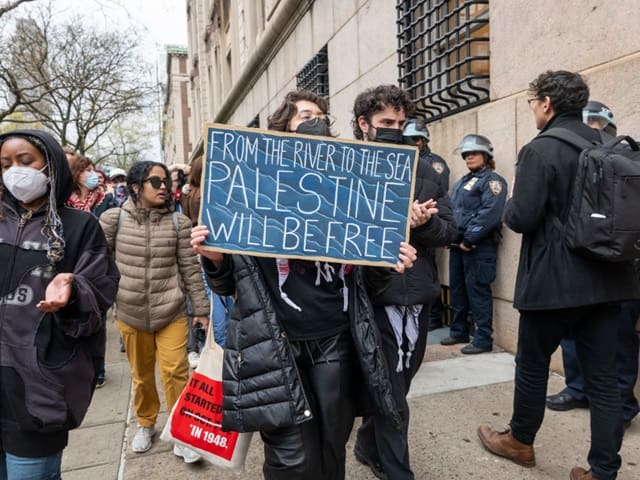
The events of October 2023 gave rise to an array of public demonstrations–both in support of Israel, denouncing of the horrific actions of Hamas militants, and against Israel and the Israeli government and its military response to those actions–around the world, including in the United States and in Israel. Some demonstrators took the opportunity to address issues of long-term dispute in the region, including calls for increased autonomy for Palestinians in Israel and/or for a Palestinian state. While the protests in the United States occurred in a wide range of locations, the overwhelming media attention quickly focused on protests on university campuses around the country, which included demonstrations at over fifty colleges and universities in more than twenty states. Much of this media attention, and then the broader public’s focus, then shifted to one perceived aspect of the protests: that the protests, and associated activities, included antisemitic speech and conduct. Students, parents, and others who observed this aspect of the demonstrations expressed both fear and outrage, with the latter group focusing on the students who engaged in the allegedly bigoted activities and the university administrators who allowed them to occur and continue. Many of these public complaints came from high-profile donors to, and board members of, some of the most prestigious universities in the nation. In addition to the public denunciations, many donors announced their plans to withdraw past donations and to forgo any future ones, resigned from leadership positions at universities, or threatened to do both, in response to what they saw as insufficient institutional responses to what they alleged were not just anti-Israel but also (perhaps, for some, by definition20) antisemitic protests.
Elected officials soon responded to the evolving dynamic. Several hearings were convened in the U.S. Congress addressing concerns about antisemitism on college campuses, including several by Republicans on the House Committee on Education and the Workforce. The first and highest profile of these hearings occurred on December 5, 2023, when the presidents of Harvard, the University of Pennsylvania (UPenn), and Massachusetts Institute of Technology were asked about statements made by protestors and whether those statements (characterized by Rep. Elise Stefanik as “calling for the genocide of Jews”) would be considered violations of each university’s code of conduct. UPenn’s President Liz Magill declined to provide a “yes or no” answer, essentially testifying that it was a complicated question, and that her school and others made careful determinations regarding the potential prohibition of speech to ensure a proper balance between the freedom of expression rights of the speaker, and the interests of the broader campus community. Magill’s response led to almost universal media and public reprobation, leading her to release a video the day after the hearing in which she clarified that calls for genocide would indeed be considered harassment and therefore subject to discipline. But the criticism did not abate–and indeed only increased–in the days after the testimony, ultimately obliging both Magill and the chair of the UPenn Board of Trustees to resign.
Testifying at the same hearing, Harvard President Claudine Gay, the first Black president in the university’s history, sought to provide a similarly nuanced response to the same question about whether statements made during Gaza protests constituted violations of student conduct codes. She also faced calls for her resignation immediately after the hearing from members of the United States Congress, media commentators, and a range of university alumni and donors. In a letter demanding her resignation, a group of mostly Republican House members referred to her answers and those of the other presidents at the hearing as “abhorrent,” also stating that “[i]t is hard to imagine any Jewish or Israeli student, faculty or staff feeling safe when presidents of your member institutions could not say that calls for the genocide of Jews would have clear consequences on your campus.” Gay initially survived the campaign to have her removed, in part because of strong support from university faculty, including former Solicitor General, law professor, and First Amendment advocate Charles Fried. But she later resigned after incidents of plagiarism in her earlier scholarship were exposed by right-wing activist Christopher Rufo (made famous over the previous few years by his ongoing campaign against the teaching of Critical Race Theory; legal protections for LGBTQ+ people; and diversity, equity, and inclusion programs and initiatives in universities and elsewhere).
The Trump administration’s response to the Gaza demonstrations has expanded dramatically in 2025. Most notably, the United States Departments of Justice and Education have conducted wide ranging investigations of scores of colleges and universities, identifying and punishing instances of failure to sufficiently protect students from antisemitism. For example, the Department of Justice announced in August 2025 that George Washington University in Washington, D.C. had violated “federal civil rights law” as a result of its “’deliberate indifferen[ce]’ to antisemitism on campus.” And in March 2025, the Department of Education announced that it had issued letters to sixty “colleges and universities … under investigation for alleged violations ‘relating to antisemitic harassment and discrimination,’ warning institutions of possible consequences if they don’t take adequate steps to protect Jewish students.”
The national furor over allegedly antisemitic statements made in the wake of the Israel-Gaza war–particularly the bipartisan demand from the Trump administration, elected officials of both parties, and others, that universities investigate, prohibit, and punish antisemitic speech on their campuses–is remarkable for at least a few reasons. First is the identity and past public statements and positions of some of those most fervently calling for colleges to regulate the speech of their students. In an article in The Atlantic, Evelyn Douek and Genevieve Lakier note that “[c]onservative lawmakers can’t seem to decide how they feel about government influencing private institutions’ speech policies.” They note that Elise Stefanik, the most consequential questioner in the House Education Committee hearing, is also “among the most vocal critics of the Biden administration’s relationship with social-media platforms,” repeatedly decrying the “weaponization of the federal government,” and calling “for an end to such ‘government meddling’ in the marketplace of ideas” in an amicus brief in the Fifth Circuit.
The second remarkable feature of this new focus on campus speech regulation is the dramatic difference in how those complaining about the harmful speech in this instance responded to similar complaints in the past. For decades, many of the most vocal critics of university leadership and their management of Gaza protests have not only shown little sympathy for past student victims of hate speech, but have also complained about the dire threats to First Amendment freedoms that these complaining students and their faculty and staff enablers pose. The unifying theme of this anguished and outraged complaint against students and their coddling universities has been advocacy for the broadest range of expression of ideas–even those the students or others might find abhorrent46–including admonitions to the complaining students that they grow up, develop thicker skins, and stop being such insipid and entitled snowflake